Load Balance
What is Load Balancer
A Load Balancer is a network device or software that distributes network or application traffic across multiple servers. The primary purpose of a load balancer is to increase resource utilization, maximize throughput, reduce response time, and ensure that the load is evenly distributed across servers, thus preventing any single server from being overloaded, ensuring high availability and reliability of applications.
The working principle of a load balancer typically involves the following steps:
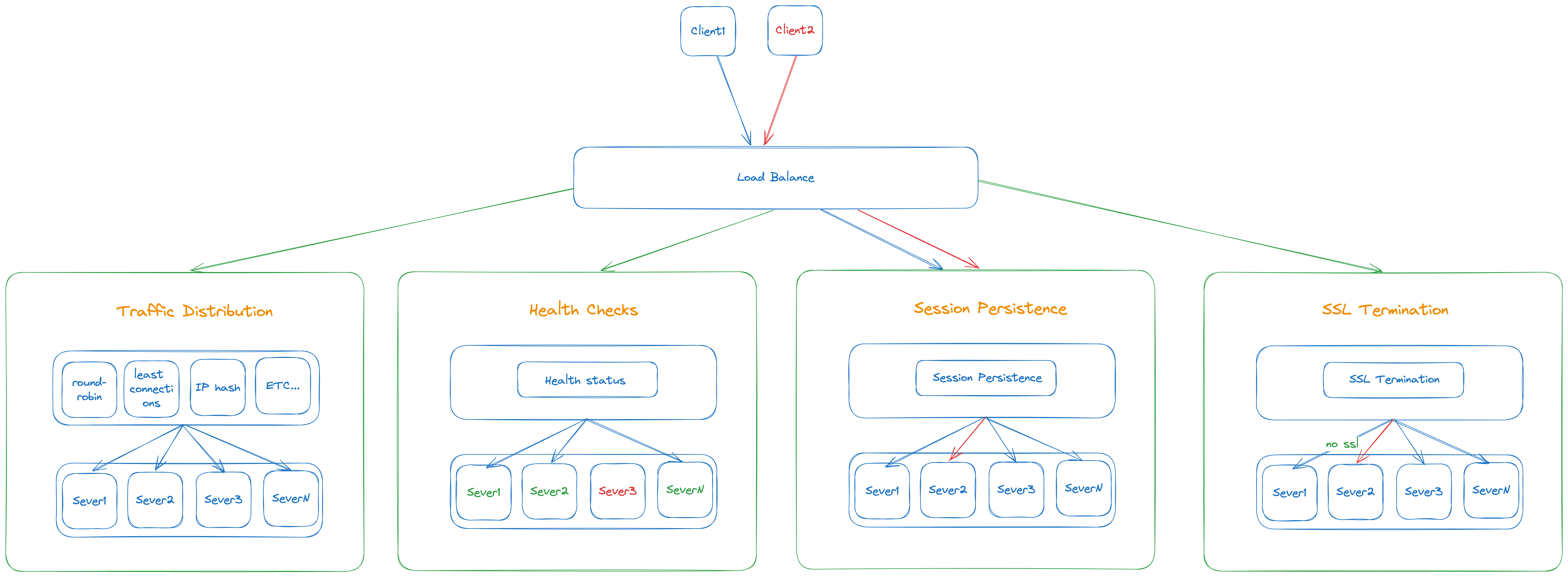
Traffic Distribution: When a client makes a request, the load balancer receives the request and decides which server to forward it to, based on predetermined policies such as round-robin, least connections, IP hash, etc.
Health Checks: Load balancers periodically check the health status of backend servers to ensure that all traffic is sent to healthy servers. If a server fails, the load balancer automatically redirects traffic to other healthy servers.
Session Persistence: In certain application scenarios, maintaining session continuity between the client and the server is necessary. Load balancers can use specific session persistence techniques (like cookie-based session affinity) to ensure requests from the same client are forwarded to the same server.
SSL Termination: Load balancers can handle encrypted SSL traffic; they decrypt the encrypted requests upon receipt and then forward them in plain text to the backend servers. This can reduce the computational burden on the backend servers.
Load balancers can be deployed on physical hardware, virtual machines, or as part of cloud services. They play a crucial role in ensuring websites, applications, and databases can handle high traffic and provide stable service.
步骤和对应的层
在负载均衡器的工作原理中,不同的步骤可能会基于不同的层(L4 或 L7)来执行。
- 流量分发:
- 基于L4:当负载均衡器根据源和目的IP地址以及端口号(TCP/UDP)来决定将请求转发给哪台服务器时,这是基于第四层(传输层)的操作。这种方式关注于网络层面的信息,如IP地址和端口。
- 基于L7:如果负载均衡器在决策时考虑了HTTP头、URL、cookies等应用层信息,那么这属于第七层(应用层)的操作。这种方式允许根据更复杂的应用数据(如URL路径、请求类型)来做路由决策。
- 健康检查:
- 可以是基于L4或L7:健康检查既可以在第四层进行,通过简单的端口检测来确认服务器是否在线;也可以在第七层进行,通过发送特定的HTTP请求并检查响应来更细致地评估服务器的健康状况。
- 会话保持:
- 基于L7:会话保持(如基于cookie的会话粘性)通常需要处理HTTP请求和响应中的应用层信息,因此是基于第七层的功能。
- SSL终止:
- 基于L7:SSL终止涉及到解密HTTPS流量以查看HTTP内容,因此它是在应用层完成的。这允许负载均衡器在解密流量后基于HTTP请求内容做出路由决策。
综上所述,流量分发可以基于L4或L7,具体取决于决策所依据的信息类型;健康检查可以在L4或L7层实施;会话保持和SSL终止是典型的基于L7的操作。
网络七层协议
网络的7层通常指的是OSI(开放系统互连)模型,这是一个由国际标准化组织(ISO)定义的网络通信标准框架。OSI模型将网络通信分为七个抽象层,每一层都有其独特的功能和协议。这些层从底层的物理连接到顶层的应用程序界面,依次是:
- 物理层(Physical Layer)
- 功能:负责传输原始比特流(即0和1)通过物理媒体(如电缆、光纤、无线电波)。
- 例子:以太网电缆、光纤连接、RJ45。
- 数据链路层(Data Link Layer)
- 功能:在物理连接的基础上提供可靠的数据传输,处理错误检测和修正,以及帧同步(将比特组织成帧)。
- 例子:以太网(Ethernet)、PPP(点对点协议)、MAC(媒体访问控制)地址。
- 网络层(Network Layer)
- 功能:负责数据包从源到目的地的传输和路由选择,包括分段和封装。
- 例子:IP(互联网协议)、ICMP(互联网控制消息协议)。
- 传输层(Transport Layer)
- 功能:提供端到端的通信服务,确保数据的完整性,处理流量控制、错误检查、数据重组等。
- 例子:TCP(传输控制协议)、UDP(用户数据报协议)。
- 会话层(Session Layer)
- 功能:管理应用程序之间的会话,包括会话的建立、维持、终止。
- 例子:NetBIOS(网络基本输入输出系统)、SSH(安全壳协议)。
- 表示层(Presentation Layer)
- 功能:确保从一个系统发送的数据能被另一个系统的应用层理解,包括数据格式转换、数据加密和解密。
- 例子:JPEG、ASCII、加密协议。
- 应用层(Application Layer)
- 功能:为应用程序提供网络服务,直接支持用户和应用程序的各种网络活动。
- 例子:HTTP(超文本传输协议)、FTP(文件传输协议)、SMTP(简单邮件传输协议)。
OSI模型帮助设计者和工程师分层地考虑网络问题,尽管实际网络协议栈(如TCP/IP模型)并不完全按照OSI模型的分层结构划分,OSI模型仍然是理解网络通信的重要理论基础。